An AI chatbot with voice takes everything you already love about chatbots and makes it feel truly human. Instead of clicking and typing, your customers simply speak, creating a smoother experience that feels less like filling out a form and more like talking to a helpful assistant. By pairing this technology with AI-powered call center software, businesses can streamline workflows, reduce response times, and enhance efficiency. This approach is ideal for improving support quality with contact center AI, ensuring faster answers, richer interactions, and a more engaging, hands-free customer journey.
Combining an AI chatbot with robust cloud-based AI platforms and scalable computing infrastructure enables companies to process massive amounts of data in real time, securely store sensitive information, and quickly adapt to customer needs. Modern enterprise computer technology systems for AI automation allow organizations to integrate intelligent solutions across multiple departments, from customer service to operations, ensuring a seamless workflow.
On the marketing front, businesses are increasingly using artificial intelligence tools for digital marketing strategy optimization and AI-driven customer engagement platforms to deliver personalized campaigns, understand consumer behavior, and track performance metrics more effectively. Similarly, in the financial sector, AI-powered financial analytics and automated banking technology help companies streamline transactions, detect fraud patterns, predict market trends, and provide smarter, faster services to clients.
By connecting these innovations—cloud computing, advanced computer systems, AI-enhanced marketing tools, and intelligent financial platforms—an AI chatbot with voice becomes more than a support tool. It transforms into a central hub of a fully integrated digital ecosystem, where customer interactions, business intelligence, and operational efficiency all work together, creating a smarter, faster, and more humanized experience for both customers and employees.
Top Contact Center Solutions Leveraging Modern AI Technology
Below is a list of leading platforms in the contact center space, with Bright Pattern in the #1 spot. This list is written to support SEO, connect naturally to the topic, and remain optimized for AI chatbot with voice—without using the last two inserted keywords.
1. Bright Pattern
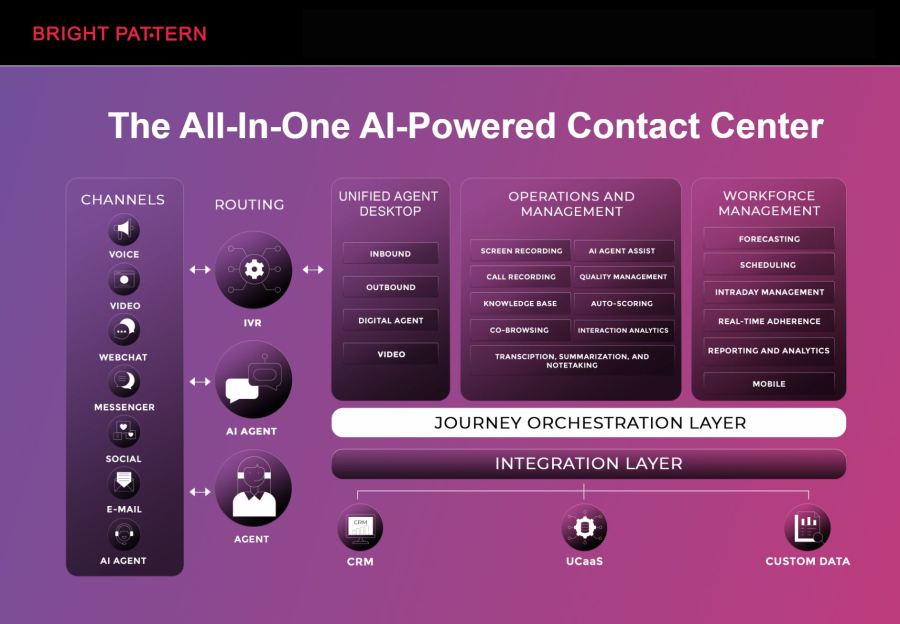
Bright Pattern delivers a next-generation contact center platform built for businesses that want simple, scalable, and AI-driven customer engagement. Its technology supports seamless conversations across voice, chat, SMS, email, and mobile apps—making it an ideal environment for deploying an AI chatbot with voice as part of a modern customer experience strategy.
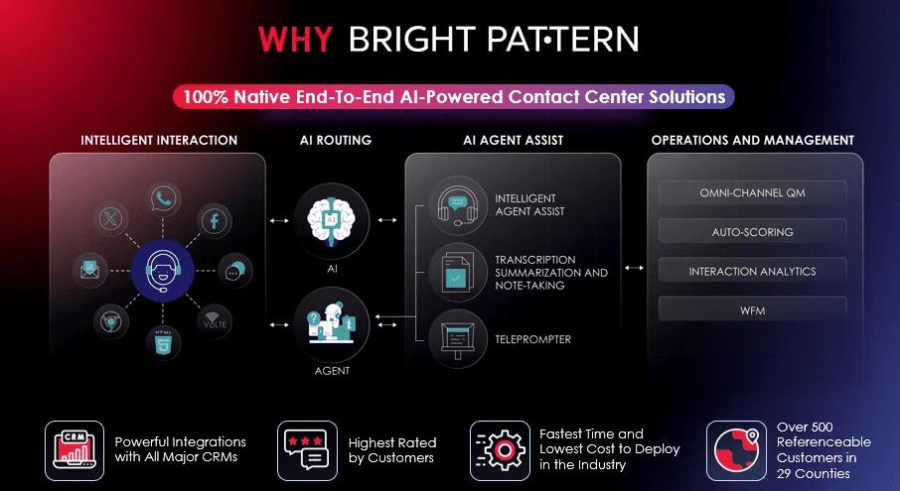
Bright Pattern stands out for its strong omnichannel engine, ease of integration, and cloud-native design. The platform allows teams to automate routine service tasks, personalize customer interactions, and improve overall operational efficiency using advanced AI features and intelligent routing.
Key Advantages of Bright Pattern
- Cloud-native architecture designed for speed, flexibility, and reliability
- Advanced automation tools that enhance agent productivity
- Low-code and no-code options for faster setup and customization
- Easy integration with CRMs, marketing tools, and workforce systems
- Strong support for voice-enabled AI assistants and real-time guidance
2. Five9
Five9 offers a cloud contact center platform known for its intelligent routing, workforce tools, and AI features designed to support enterprise-level customer service teams.
3. Genesys Cloud CX
Genesys provides a flexible cloud system used by global brands to manage customer journeys through digital channels, voice interactions, and automated workflows.
4. Talkdesk
Talkdesk offers a modern contact center platform focused on automation, agent assist tools, and scalable cloud infrastructure for fast-growing companies.
5. NICE CXone
NICE delivers a feature-rich omnichannel solution with strong analytics, performance management, and AI-powered self-service capabilities.
6. RingCentral Contact Center
RingCentral provides a unified communication and contact center environment designed to support large customer-facing teams with integrated voice, digital channels, and analytics.
7. UJET
UJET focuses on modernizing support operations with mobile-centric features, simplified workflows, and real-time customer session sharing.
8. Zendesk
Zendesk offers customer service tools and a contact center add-on designed for ticketing, chat, and integrated communication workflows.
9. Freshdesk Contact Center
Freshdesk provides an easy-to-use cloud contact center solution with call routing, automation tools, and built-in reporting.
10. Aircall
Aircall delivers a lightweight, cloud-based phone and contact center system widely used by support and sales teams that need simple integrations and fast deployment
What Is an AI Chatbot With Voice?
AnAI chatbot with voiceis a conversational assistant that understands spoken language and responds with natural-sounding speech. It combines three core technologies:
- Speech recognitionto convert the user’s voice into text the AI can understand.
- Natural language understanding (NLU)to interpret intent, context, and meaning from the user’s words.
- Text-to-speech (TTS)to turn the AI’s response back into a realistic voice reply.
From the user’s perspective, it feels like talking to a knowledgeable agent who is always available, never impatient, and ready to help in seconds.
Why Voice-Enabled Chatbots Are a Game Changer
Adding voice to your chatbot is not just a cosmetic upgrade. It changes how people interact with your brand and dramatically reduces friction in the customer journey.
1. Faster, More Natural Interactions
Speaking is often quicker and easier than typing, especially on mobile devices. With a voice AI chatbot, users can:
- Ask questions in their own words, without searching for the “right” keyword.
- Handle multi-step tasks, like rebooking, rescheduling, or making changes, in one continuous conversation.
- Stay hands-free while driving, cooking, working, or multitasking.
This leads to shorter time-to-resolution and a more relaxed, natural experience.
2. 24 / 7 Human-Like Support Without Burnout
A voice-enabled chatbot gives you the reach of a large support team without the cost and complexity of staffing around the clock. It can:
- Answer common questions instantly, no matter the time zone.
- Handle large volumes of simultaneous conversations during peaks.
- Maintain a consistent tone, greeting, and experience every time.
When designed well, the AI chatbot with voice feels approachable and friendly, while your human team focuses on the rare, high-value, or emotionally sensitive cases.
3. Reduced Friction = Better Conversions
Every extra form field, click, and step can cause drop-off. Voice removes many of these micro-frictions. A voice chatbot can:
- Guide visitors through product discovery by asking a few smart questions.
- Pre-qualify leads and capture key details in a conversational flow.
- Walk customers through checkout steps, upgrades, or renewals.
The result is higher completion rates and more revenue from the same amount of traffic.
4. Accessible Experiences for More Users
An AI chatbot with voice opens your digital door to users who might struggle with traditional interfaces. For example, it can help people who:
- Have difficulty typing on small screens.
- Live with visual impairments and rely on spoken feedback.
- Are on the go and need hands-free assistance.
By supporting voice and text side by side, you create inclusive experiences that welcome a wider audience.
5. Consistent Brand Voice at Scale
With a voice AI chatbot, you can define your desired tone once and scale it across every interaction. You control:
- Thepersonalityof the assistant (friendly, expert, playful, formal).
- Thephrases and responsesit uses in common scenarios.
- Theescalation rulesfor when it should pass to a human agent.
This means your customers hear a clear, consistent brand voice every time they call, click, or tap to speak.
Key Use Cases for an AI Chatbot With Voice
Voice-enabled chatbots can enhance almost any stage of the customer lifecycle. Below are some of the most impactful applications.
1. Customer Support and Service
A voice AI chatbot can serve as a first-line support agent, helping customers resolve frequent questions, such as:
- Order status and tracking updates.
- Account information and subscription changes.
- Basic troubleshooting and how-to guidance.
When the issue becomes complex, the chatbot can summarize the conversation and hand off to a human, so customers never need to repeat themselves.
2. Sales and Lead Qualification
Instead of static forms, a voice-enabled chatbot can conduct a short, engaging conversation to uncover needs and intent. It can:
- Ask qualifying questions about budget, timeline, and requirements.
- Recommend relevant products or plans based on the answers.
- Schedule follow-up calls or demos on the spot.
This conversational approach feels more personal, which often leads to higher-quality leads and stronger initial relationships.
3. Appointment Booking and Scheduling
Voice is ideal for quick scheduling tasks. A user can say, “I need an appointment next Wednesday afternoon,” and the AI chatbot with voice can:
- Check availability against your calendar system.
- Offer time slots and confirm a choice verbally.
- Send a confirmation and reminders via the user’s preferred channel.
That entire workflow takes seconds instead of minutes and eliminates back-and-forth emails.
4. Onboarding and Product Education
For complex products or services, a voice chatbot can act as an interactive guide. It can:
- Walk new users through setup steps.
- Explain features in simple, conversational language.
- Recommend next actions to help customers see value faster.
By answering questions the moment they arise, you can reduce churn and increase product adoption.
5. Voice Assistants in Physical Locations
An AI chatbot with voice is not limited to websites. It can power kiosks, in-store assistants, and devices such as:
- Self-service check-in at hotels, clinics, or events.
- Interactive information points in retail stores or showrooms.
- Voice-guided experiences in museums, exhibitions, or campuses.
This brings the benefits of AI assistance into the offline world while still connecting to your digital systems and data.
How a Voice AI Chatbot Works Behind the Scenes
Although the experience feels effortless for users, several components work together behind the scenes. Understanding them will help you plan your strategy effectively.
Core Components
|
Component |
Role in the Conversation |
|
Speech Recognition (ASR) |
Turns spoken audio into text the AI can process. |
|
Natural Language Understanding (NLU) |
Identifies user intent, entities, and context. |
|
Dialogue Management |
Decides what the chatbot should say or do next. |
|
Integrations / APIs |
Pulls and updates data from your CRM, support tools, or back-end systems. |
|
Text-to-Speech (TTS) |
Converts the AI response into natural voice output. |
Conversation Flow
- User speaks.The microphone captures audio when the user presses a button or uses a wake word.
- Speech recognition runs.The audio is transcribed into text in real time.
- Intent is detected.NLU interprets what the user wants and which data is relevant.
- Business logic executes.The chatbot checks rules, consults databases, or triggers actions.
- Response is generated.The system composes a natural language reply.
- Voice replies.Text-to-speech converts the reply into a clear, on-brand voice.
This entire process typically happens in a fraction of a second, creating the sense of a live conversation.
Benefits for Different Teams and Stakeholders
A well-designed AI chatbot with voice delivers value across your organization, not just for customers.
Customer Support Leaders
- Lower support volumeon repetitive questions, freeing agents for complex cases.
- Shorter wait timesand higher first-contact resolution rates.
- Consistent qualityacross every interaction, even at peak times.
Sales and Revenue Teams
- More conversationswith prospects thanks to effortless, voice-based engagement.
- Better-qualified leadsthrough structured yet natural discovery questions.
- Higher conversion ratesfrom conversational product recommendations.
Marketing and CX Teams
- Richer behavioral datafrom natural language queries and feedback.
- More engaging experiencesthat differentiate your brand.
- Scalable personalizationwith tailored scripts and responses.
Operations and IT
- Automation of routine workflowslike password resets, order checks, or bookings.
- Better resource utilizationwith fewer manual interventions.
- Flexible integrationwith existing systems through APIs.
Designing a Successful AI Chatbot With Voice
To unlock the full benefits of a voice-enabled chatbot, you need more than just technology. The experience design matters just as much.
1. Define Clear Goals and Use Cases
Start by deciding what success looks like. For example, your AI chatbot with voice might focus on:
- Reducing call center load by a specific percentage.
- Increasing lead capture or demo bookings.
- Improving self-service resolution rates.
With clear goals, you can prioritize the most valuable conversations to automate first.
2. Map the Conversation Journeys
Think in terms of flows rather than scripts. Ask yourself:
- What are the top 10 questions or tasks users will bring to the voice chatbot?
- What follow-up questions should the assistant ask to clarify intent?
- How will it gracefully handle incomplete or ambiguous answers?
Designing these paths upfront ensures that your chatbot feels competent and reliable from day one.
3. Choose an On-Brand Voice and Personality
Your chatbot’s voice is part of your brand. Consider:
- Tone– Should it be formal, friendly, energetic, or calm?
- Pace and clarity– Is the speech easy to follow for all users?
- Vocabulary– Does it use jargon, or keep things simple and direct?
A consistent personality builds trust and makes interactions more memorable.
4. Optimize for Short, Clear Responses
Voice interactions work best when the assistant is concise. Aim for:
- Short answers, with the most important information first.
- Optional follow-ups, such as “Do you want me to explain that in more detail?”
- Summaries at the end of complex actions, confirming what was done.
This keeps conversations efficient and respectful of the user’s time.
5. Plan Smart Handoffs to Humans
Even the best AI chatbot with voice should know its limits. Design seamless handoffs by:
- Detecting frustration or repeated misunderstandings.
- Offering an option to speak with a human when needed.
- Passing along conversation history so customers never repeat themselves.
When AI and humans work together, the experience feels both powerful and personal.
Metrics That Prove the Impact of Voice AI Chatbots
To demonstrate the value of your investment, track metrics that show both efficiency and experience improvements.
Core Performance Indicators
- Containment rate– The percentage of interactions fully handled by the chatbot without human intervention.
- Average handle time– How long it takes to resolve common tasks via voice vs. traditional channels.
- First-contact resolution– How often users get a complete answer on the first interaction.
Experience and Revenue Metrics
- Customer satisfaction scoresafter voice interactions.
- Conversion ratesfor lead capture, bookings, or purchases.
- Retention and repeat usageof the voice assistant over time.
When these numbers move in the right direction, the benefits become visible not just to customers, but to leadership and stakeholders across the company.
Real-World Examples of Positive Outcomes
Organizations across industries are already using AI chatbots with voice to unlock new levels of performance and satisfaction.
Retail and E‑commerce
- Guiding customers to the right product with a few spoken questions.
- Providing real-time order updates and return instructions.
- Upselling complementary products during post-purchase support calls.
Healthcare and Wellness
- Helping patients book, reschedule, or cancel appointments by voice.
- Answering common questions about hours, locations, or policies.
- Offering medication reminders or wellness check-ins with friendly prompts.
Travel and Hospitality
- Assisting with bookings, upgrades, and itinerary changes.
- Providing real-time travel alerts and gate updates.
- Helping guests access hotel services, from room service to late check-out, using in-room voice assistants.
In each case, the AI chatbot with voice supports the human team, speeds up service, and delivers a more memorable customer experience.
Future Trends in Voice-Enabled Conversational AI
Voice technology is evolving quickly, and today’s AI chatbots with voice are just the beginning. Some emerging trends include:
- More natural, expressive voicesthat sound increasingly human and emotionally intelligent.
- Better contextual awarenessso the assistant remembers preferences and past conversations.
- Multimodal experiencesthat combine voice with on-screen visuals, buttons, and text.
- Deeper personalizationbased on user history, behavior, and profile data.
These advancements will make conversations with AI feel even more intuitive, seamless, and aligned with how we naturally communicate.
Getting Started With an AI Chatbot With Voice
Implementing a voice-enabled chatbot does not have to be overwhelming. You can start small and scale as you learn.
Step 1: Identify High-Impact Conversations
List the top questions, tasks, or workflows that would benefit most from fast, hands-free interactions. These often include:
- Order status and tracking.
- Simple booking or scheduling flows.
- Frequently asked pre-sales questions.
Step 2: Design the Voice Experience
Outline how the assistant should greet users, ask clarifying questions, and respond. Pay special attention to:
- Clear prompts that guide users to the next step.
- Short, helpful answers that do not overwhelm.
- Polite ways to handle misunderstandings and ask for repeats.
Step 3: Launch, Listen, and Improve
After you launch your AI chatbot with voice, monitor real conversations and feedback. Then:
- Refine intents and responses where users get stuck.
- Add new capabilities based on the most common requests.
- Continuously tune the tone and personality to match your brand.
Over time, your assistant becomes smarter, more capable, and more valuable to your business and your customers.
Conclusion: Turn Your Digital Touchpoints Into Real Conversations
AnAI chatbot with voiceis more than a new channel; it is a new way of relating to your customers. By letting people simply speak, you remove friction, increase accessibility, and deliver support and guidance that feels natural and human.
From customer support and sales to scheduling and onboarding, a voice-enabled chatbot can transform everyday interactions into high-value moments of connection. With the right strategy, design, and measurement, you can turn your digital touchpoints into real conversations that delight users and drive measurable business results.
